Nuclearization of the territory (80 km around Bure)
ANDRA (the National Radioactive Waste Management Agency) established itself in the Meuse region in 1999 with the acquisition of the first 20 hectares of the current laboratory. Since then, thanks to a collaboration with the agricultural land management organization SAFER of the Meuse, ANDRA was able to put several hundred hectares of agricultural and forestry land in reserve when they did not acquire them directly through dealings that sometimes took on the appearance of harassment and blackmail for future expropriation. These are now 3000 hectares of land at its disposal and recently it has undertaken the acquisition of buildings in certain villages. This land serves as a currency for the plots that interest them and which are determined over time during the determination of their project.
In parallel with this slow installation of Cigéo, the authorities and the nuclear industry must demonstrate that they do not harm the territory by driving away its inhabitants but also work to “dynamize” it and enrich it financially and in terms of jobs. Since the project itself is not a quick source of employment, a certain number of related projects in the nuclear industry are planned for the territory of the Meuse and neighbouring Haute-Marne.
Thus the promoters of Cigéo have been holding out to entrepreneurs and local elected officials for five years a whole cluster of the nuclear industry dedicated to establishing itself in Meuse and Haute-Marne.
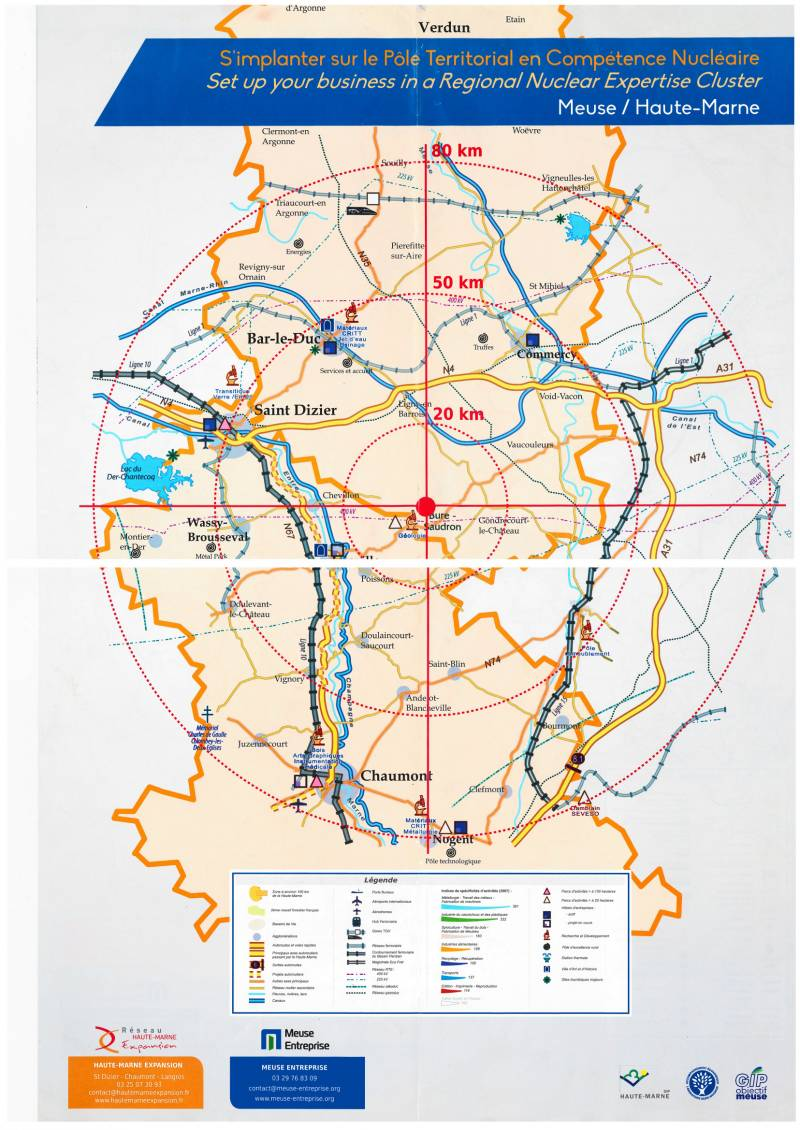
Card distributed at the 2014 World Nuclear Exhibition.
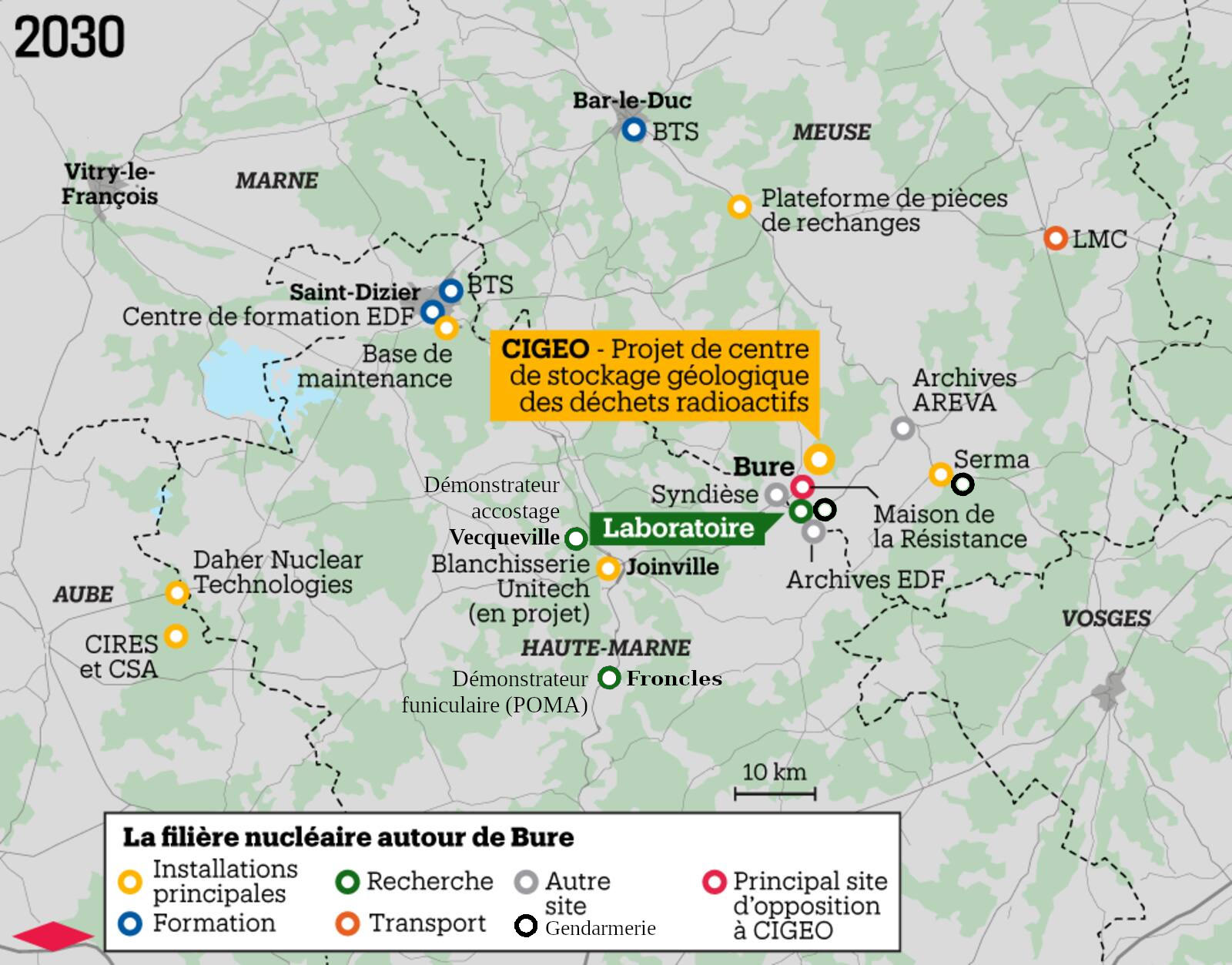
After an abortive project for a bio-fuel plant based on the pulverization of 96,000 tons of wood biomass per year in Saudron, led by the CEA, it is the low-level radioactive waste reprocessing plant in Gudmont-Villiers by Derichebourg that has reversed course, due to too strong opposition from its inhabitants. And now it is a project for a laundry of nuclear clothes in Joinville that has been sparking major protests for 2 years. EDF was, on the other hand, able to discreetly install a storage platform for parts of nuclear power plants in Velaines. In the high schools of the department, training courses are open in CAP and BTS for the nuclear industry. And Orano and EDF have set up archive centres in Bure and Houdelaincourt. All of this remains very marginal for the moment and is more a smokestack than a real development of territory. These are barely a hundred jobs cumulated and not necessarily filled locally in the end.
Here is a 2026 maps of different project linked to Cigeo and the nuclear industry in general
With each nuclearization project, its struggle
Fight against the nuclear laundry of Joinville.
The latest news about this project : https://bureburebure.info/en/unitech-rode-toujours-ne-baissons-pas-la-garde/
Other ongoing projects :
In the hyper-proximity area of Cigéo, EDF proposes to establish a storage center for bulky parts and defective spare parts, before transfer to suppliers for repair. A plot of approximately 8,000 m2 has been acquired in the municipality of Bure. The investment would amount to €5 million for a commissioning scheduled for 2023. A national base for the maintenance of cold tools in the park will be hosted at Tronville-en-Barrois. Objective : optimize the management, maintenance, regulatory controls and provision of these conventional tools. The rough draft advanced in 2019, and is completed, paving the way for the detailed draft. The allotment of the tender will allow local companies to compete. The work will start in mid-2021, with a budget of €16 million, and commissioning scheduled for mid-2022.
(Andra’s 2019 activity report)
2026 Update : the storage center has been announced again this spring and a datacenter project has been advertised and then canceled.
Note : the argument of desertification of the territory, including by opponents to point out the opportunism of the establishment of ANDRA, may also have contributed to further invisibilizing the wealth of the existing in this department which has an alternative life, popular and cultural particularly dense and rich relative to its poverty. Similarly, the apparent aridity and destitution of the Bure plateau, very agricultural, surrounded by wind turbines and crowned by its laboratory that resembles a huge factory, give visitors, activists, journalists, researchers or engineers the feeling that the region is hostile, empty and without a future, that Cigéo is perhaps ultimately less worse here than elsewhere. Yet the very wooded valleys and lush in biodiversity nearby and picturesque and ancient villages that dot the two valleys of the Ornain and the Saulx north of Bure give to see a completely different aspect of the territory.